
Whitfield County Court Records After Arrest
After a Whitfield County arrest, the first public trail is usually a jail record. The Whitfield County Jail booking entry may show the arrest date, booking agency, a primary charge, per-charge bond fields, a docket number, and a court date if one has been entered. That jail record is useful, but it is not the same thing as a court case. Formal court records are maintained through the clerk and court system after a case is opened, filed, or routed for hearing.
The main online case portal is Whitfield County CM Web Search. It offers party-name and case-number searches for public case information. The portal warns users to search name variations and to treat the index as a public service rather than a certified record. Questions about portal data may route to the local clerk contact shown in the portal disclaimer, while Superior Court criminal records are handled through the Clerk of Superior Court.
For the custody side of the arrest, use Whitfield County jail inmate records. For booking-photo limits and request routes, use Whitfield County jail mugshots. Court records after a jail arrest answer a different question: what case was filed, which court has it, and what happened to each charge.
Find Whitfield County Court Records
CM Web Search is the best starting point when the goal is to find Whitfield County court records after an arrest. A party search works when only the defendant name is known. A case-number search works when the jail roster, citation, warrant paperwork, attorney, or court notice gives a docket number. If the case is older, image-limited, sealed, juvenile, or not indexed the way a reader expects, the clerk or court office may still be needed.
- Open Whitfield County CM Web Search and choose either Search By Party or Search By Case Number.
- For a party search, enter the last name first, then the first name. Use at least two letters and do not add a suffix.
- For a case-number search, enter the year and six-digit case number. Add case type or status only if known.
- Open the matching case and compare charge entries, docket activity, filings, and hearing dates with the jail record.
- If the match is uncertain, contact the proper court office before relying on the result.
The official party-name search form is shown below. It is useful when a person was booked into Whitfield County Jail but the docket number has not been found yet.
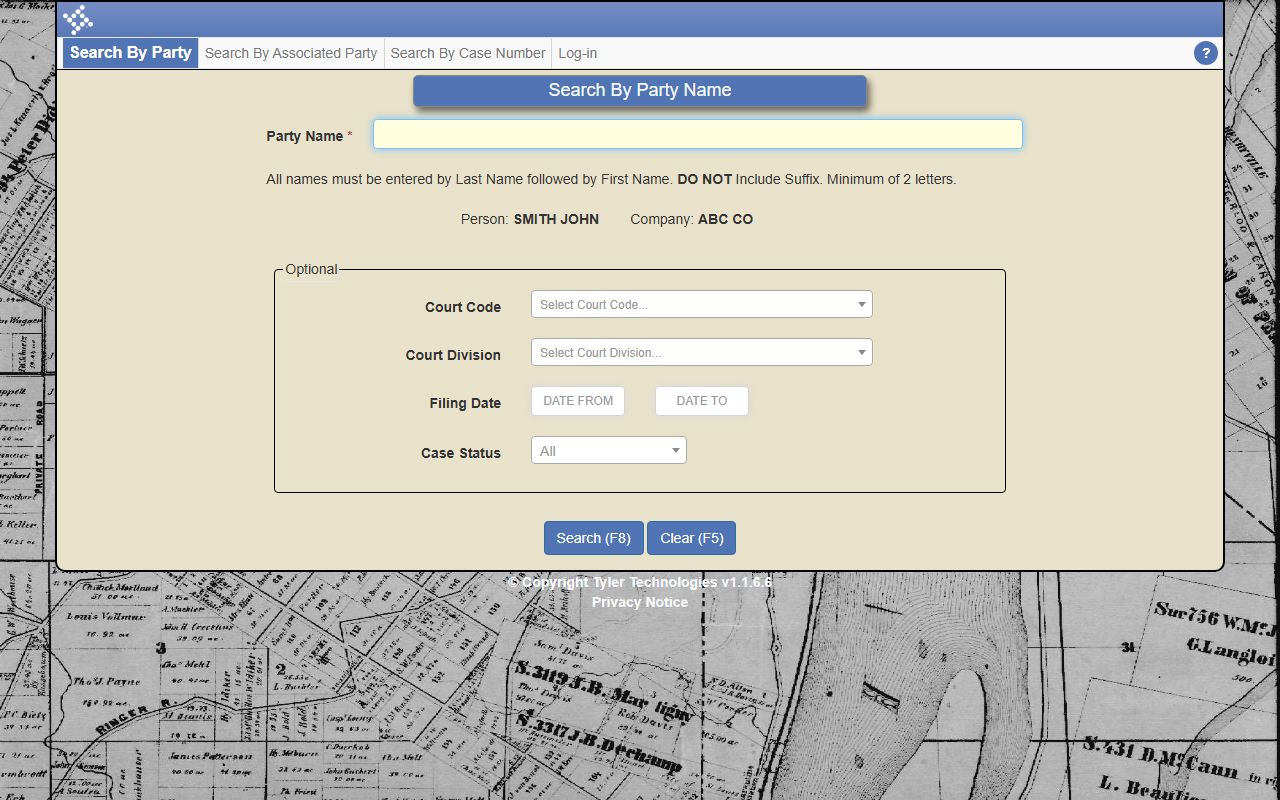
The party form also allows optional court code, division, filing-date, and active or inactive case filters, which can help separate similarly named defendants.
| Party Search Field | Required | Whitfield County Notes |
|---|---|---|
| Party Name | Yes | Last name followed by first name, at least two letters, no suffix. |
| Court Code | No | Optional filter. The case-number page showed Magistrate Court as MG. |
| Court Division | No | Optional division filter when a division is known. |
| Filing Date From/To | No | Use when the arrest or filing time frame is known. |
| Case Status | No | ACTIVE and INACTIVE options were observed. |
Whitfield County Arrest Case Numbers
A case-number search is more precise than a name search. The Whitfield court portal requires the filing year and a six-digit case number. The inspected case-number form also showed optional court code, court division, case type, and active or inactive status filters. For Magistrate Court matters, the local web-search instructions explain that the first four numbers are the filing year and the last six are the actual case number.
The case-number search form is a good match when a jail record, citation, warrant application, bond paper, or court notice gives a docket reference.
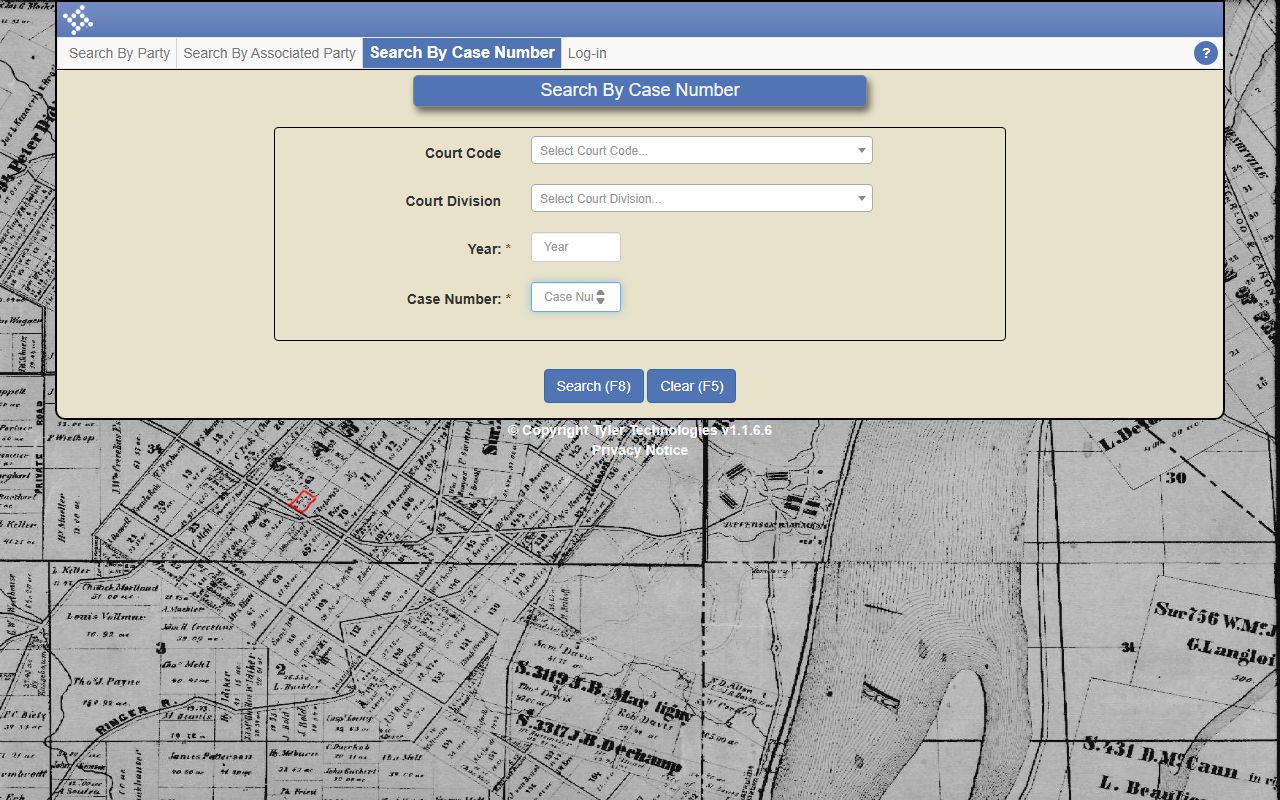
Magistrate Court web-search instructions also state that scanned information is available only for cases filed as of August 2011, and that there is no charge to print from the web.
| Case-Number Field | Required | Whitfield County Notes |
|---|---|---|
| Court Code | No | Optional. MAGISTRATE COURT (MG) was observed. |
| Court Division | No | Optional division filter when known. |
| Year | Yes | Four-digit filing year. |
| Case Number | Yes | Six-digit number, padded with leading zeroes by the portal script. |
| Case Type | No | CRIMINAL and CIVIL options were observed. |
| Case Status | No | ACTIVE and INACTIVE options were observed. |
The local prefix can also help explain what kind of Magistrate Court matter is being viewed.
| Prefix | Meaning | Why It Matters After Arrest |
|---|---|---|
| MG | Magistrate Court | Lower-court docket context for early criminal and civil matters. |
| PW | Pre-warrant application | May appear before an arrest warrant is issued. |
| WM | Warrant misdemeanor | Can connect a misdemeanor warrant to a later booking. |
| WF | Warrant felony | Can connect a felony warrant path to Superior Court review. |
| CC, CD, CG | Civil suit, dispossessory, garnishment | These are not criminal arrest prefixes, but may appear in name searches. |
Charging Documents After Arrest
Once a person is booked, the court case depends on the document that brings the charge into court. A complaint, accusation, information, warrant application, or indictment can be part of the path, depending on the charge and court. Whitfield Magistrate Court handles warrant and first-stage matters, while Superior Court has felony criminal jurisdiction in the Conasauga Judicial Circuit. The Conasauga Judicial Circuit District Attorney represents the State of Georgia in Superior Court criminal cases.
| Document | Who Uses It | What It Does |
|---|---|---|
| Complaint or warrant application | Law enforcement or an applicant through Magistrate Court | Starts or supports a warrant, citation, or first-stage criminal matter. |
| Accusation or information | Prosecutor | States the formal charge the State chooses to pursue without using the original booking wording as the final word. |
| Indictment | Grand jury | Allows felony prosecution to proceed on charges found by the grand jury. |
Formal charges may be different from the arrest entry. Prosecutors can amend, reduce, add, dismiss, or decline charges after reviewing reports, witness statements, lab results, and the law. A booking record should be read as an intake record, not proof that the filed court case will keep the same charge list.
Whitfield County Arrest Courts
Whitfield County Magistrate Court is listed at 205 N. Selvidge Street, Suite E, Dalton, GA 30720. The official page names Chief Magistrate Chris Griffin and Clerk Judy Castaneda, with phone 706-278-5052. Magistrate Court is important after an arrest because warrants, first appearances, lower-level matters, and early case activity may route through that court.
Superior Court handles felony criminal jurisdiction for Whitfield County as part of the Conasauga Judicial Circuit. The Clerk of Superior Court is Babs Bailey at 205 N. Selvidge Street, Dalton, GA 30720. The clerk lists main phone 706-275-7450, criminal division 706-275-7490, and civil division 706-275-7480. The District Attorney, Benjamin Kenemer, is also listed at 205 N. Selvidge Street, Dalton, GA 30720, with phone 706-876-1300.
Local geography: The jail and sheriff's office are on Professional Boulevard, while court records, clerk offices, Magistrate Court, Superior Court, and the District Attorney are downtown on Selvidge Street.
Whitfield County Charge Status
Charge status is the part of a court record that tells whether the case is still open, changed, or resolved. The jail roster may show active bond fields, but court records after an arrest show the legal status of the filed case. Read each count separately. One charge can be dismissed while another remains pending, and a bond change does not always mean the charge was dropped.
| Status | What It Means | Reader Caution |
|---|---|---|
| Pending | The case or charge is still open. | Check future hearing dates and bond orders. |
| Amended | The prosecutor changed the filed charge. | Compare the newest charge text with the booking charge. |
| Reduced | The charge was lowered from the earlier severity. | The arrest entry may still show the older wording. |
| Dismissed | The charge ended without conviction. | Confirm whether all counts or only one count was dismissed. |
| Nolle prosequi | The prosecutor declined to continue the prosecution. | This is not the same as an acquittal, but it ends that prosecution path. |
| No bill | The grand jury did not indict. | Look for any other active counts or later filings. |
Bond After Whitfield County Arrest
Bond information may appear in the Whitfield P2C jail record and in the court file. The jail records bond data and processes release when authorized, but the court controls many release decisions. The WCSO inmate handbook says inmates held in lieu of bond, held by court order, or held by a judge's authority must address early release through the court or judge. A no-bond order, probation hold, detainer, or outside-agency hold can block release even if another bond amount appears.
| Bond Type | How It Works |
|---|---|
| Property bond | Bond secured by qualifying property. This type was observed in Whitfield roster examples. |
| No bond | No release bond is currently available for that charge or hold. |
| Cash bond | The full amount is paid directly where the court allows it. |
| Surety bond | A licensed bonding company posts bond for a fee. |
| PR or own recognizance | Release on promise and conditions rather than an upfront cash payment. |
Bond-company names and phone numbers are listed by WCSO on its public information page, but court records should still be checked for no-bond orders, court holds, and hearing updates before assuming payment will cause release.
Warrants and Court Holds
No verified official Whitfield County page was located that functions as a complete active-warrant database. The Whitfield County Sheriff's Office, led by Sheriff Darren J. Pierce, operates the jail records side of the process, but the research did not verify any sheriff portal module as a complete warrant source. A person may not appear in jail custody until a warrant is executed. Once the warrant leads to booking, the P2C roster may show charge codes, docket or warrant-related numbers, bond status, and court date.
Official warrant-related material points to Magistrate Court. The arrest warrant and citation application form asks for defendant details, incident facts, law-enforcement report information, requested court action, and a non-refundable application fee. Magistrate Court can be reached at 205 N. Selvidge Street, Suite E, Dalton, GA 30720, phone 706-278-5052. For an active warrant, do not rely on a web search alone. Contact the court, an attorney, or law enforcement, since going to a law-enforcement office may result in arrest.
Charges vs Convictions
An arrest charge, a court charge, and a conviction are different records. The arrest charge explains why the person was booked. The filed charge explains what the State or court is pursuing. A conviction requires a guilty plea, verdict, or other qualifying adjudication. Court records after arrest should never be read as proof of guilt unless the disposition shows a conviction.
| Question | Charge | Conviction |
|---|---|---|
| Stage | An accusation filed or listed after arrest. | A final guilt finding, plea, or qualifying disposition. |
| Standard | Based on probable cause or prosecutor filing decisions. | Based on proof, plea, or judgment in court. |
| Can change? | Yes. It may be amended, reduced, dismissed, or indicted differently. | Changes only through court action, appeal, withdrawal, or later relief. |
| How to verify | Check the current case docket and charge list. | Check the disposition, sentence, and final judgment entries. |
Sealed vs Restricted Arrest Records
Georgia often uses the term record restriction rather than expungement. The Georgia.gov record restriction page and the Georgia Courts self-help record restriction page point to O.C.G.A. 35-3-37 for eligibility and process. Dismissals, acquittals, no bills, and other outcomes may support restriction in some cases, but the result depends on the exact record and agency.
| Question | Sealed | Expunged or Record Restricted |
|---|---|---|
| Public view | Hidden from ordinary public viewing by law or court order. | Limited through Georgia record restriction rules when the record qualifies. |
| Common Georgia wording | Often used for court-file access limits. | Georgia commonly points users to record restriction rather than using expungement as the main term. |
| Agency access | Courts and law enforcement may still have limited access. | Some official access may remain depending on the record and statute. |
| Typical trigger | A protected case type, court order, juvenile matter, or specific exemption. | Dismissal, acquittal, no bill, or another eligible outcome may support restriction. |
Open-records exemptions can also limit access to juvenile, medical, security, privacy, and active investigative material. Georgia Open Records Act rules generally favor access to public records, but O.C.G.A. 50-18-72 allows specific redactions and denials where an exemption applies.
Background Check Limits
Casual court lookup is not the same as an official criminal-history report or a regulated background check. WCSO records, CM Web Search, clerk records, and Georgia state criminal-history processes can serve different needs. If a reader needs a certified copy, disposition, or official background check, the originating court, clerk, or law-enforcement agency should be used.
Important: Court and jail lookup information may not be used for credit, employment, housing, insurance, or any other FCRA-regulated purpose.